FlowLess: Controlling Abstract Image Generation
Amir Hertz and Noah Snavely,
Google DeepMind
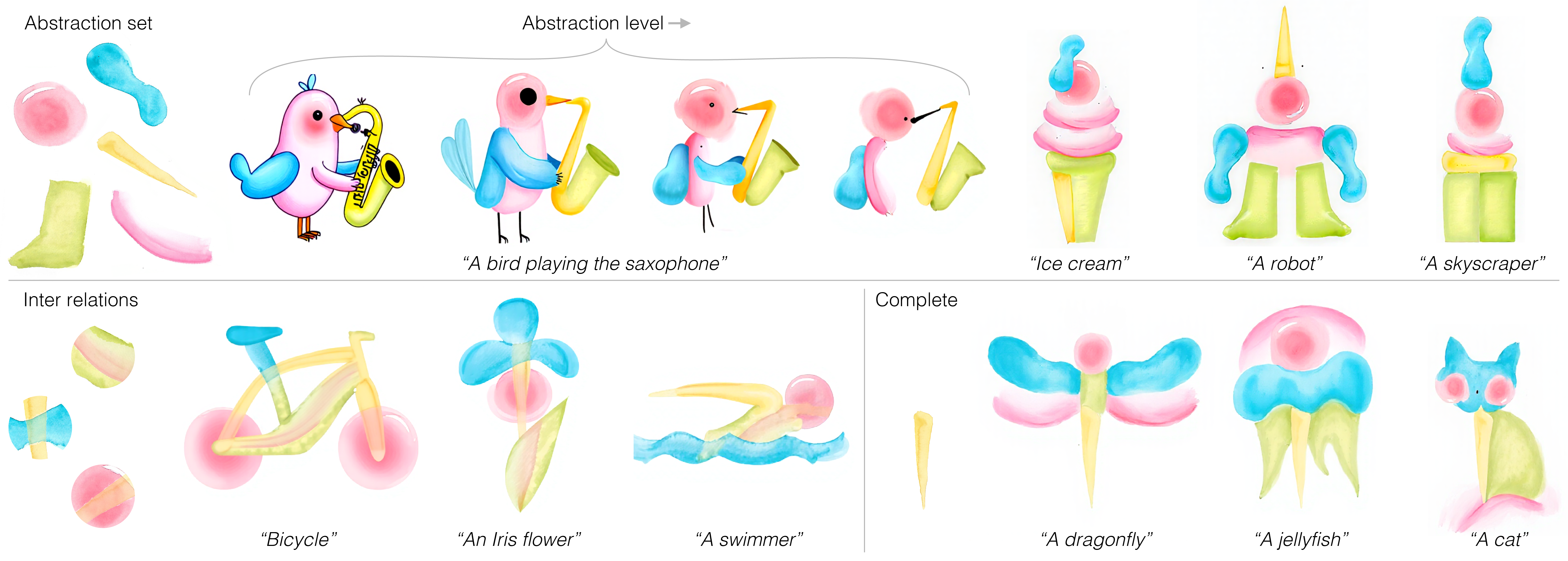
FlowLess enables image generation of different concepts from a provided visual abstraction set. We
provide further fine-grained control over the abstractness level of the generated image (top), and over the
composition of the visual elements using additional provided visual
details (bottom).
Paper
Supplementary material
Data preparation (coming soon)
Abstract
While large-scale text-to-image models excel at generating
high-fidelity content from semantic descriptions, users often lack precise control over the of non-semantic
abstract elements and the models
expressive freedom. Existing structural conditioning methods typically
impose rigid spatial layouts or global style constraints, failing to address
the need for fine grained creative control via mixture of visual primitives.
We introduce a novel self-supervised framework that enables granular
control over image generation through a visual abstraction set—a collection of disjoint shapes, textures and
composition details. By fine-tuning a
pre-trained flow model, we allow users to construct diverse semantic concepts from the same underlying
visual kit. Our method offers control over
the level of abstraction: by leveraging a training strategy based on varying geometric augmentations and
per-part modulation, users can dictate
whether the model should preserve input shapes or interpret them loosely
to fit the narrative. Furthermore, we enable control over the generation’s
expressiveness, allowing for the creation of minimal compositions. We
demonstrate that our method provides a richer, more flexible paradigm
for creative design compared to state-of-the-art baselines across diverse
styles and compositions.
Per part control
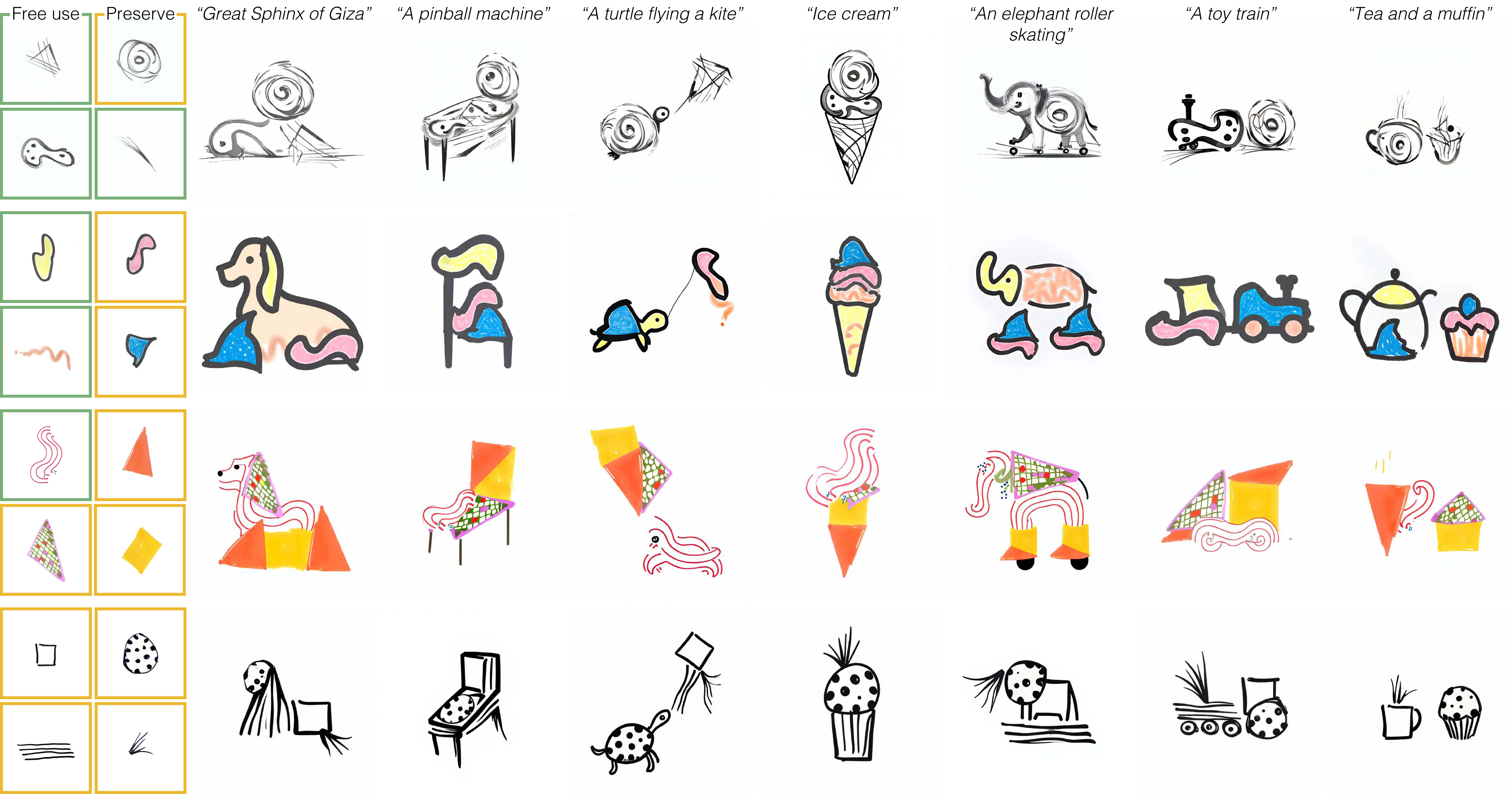
Our method enables per part abstraction control. On top, we specify the preservation of a single shape
(yellow
outline) while other elements (green outline) are combined freely into the generated image. On bottom we set
high
fidelity with respect to all four elements.
Image completion
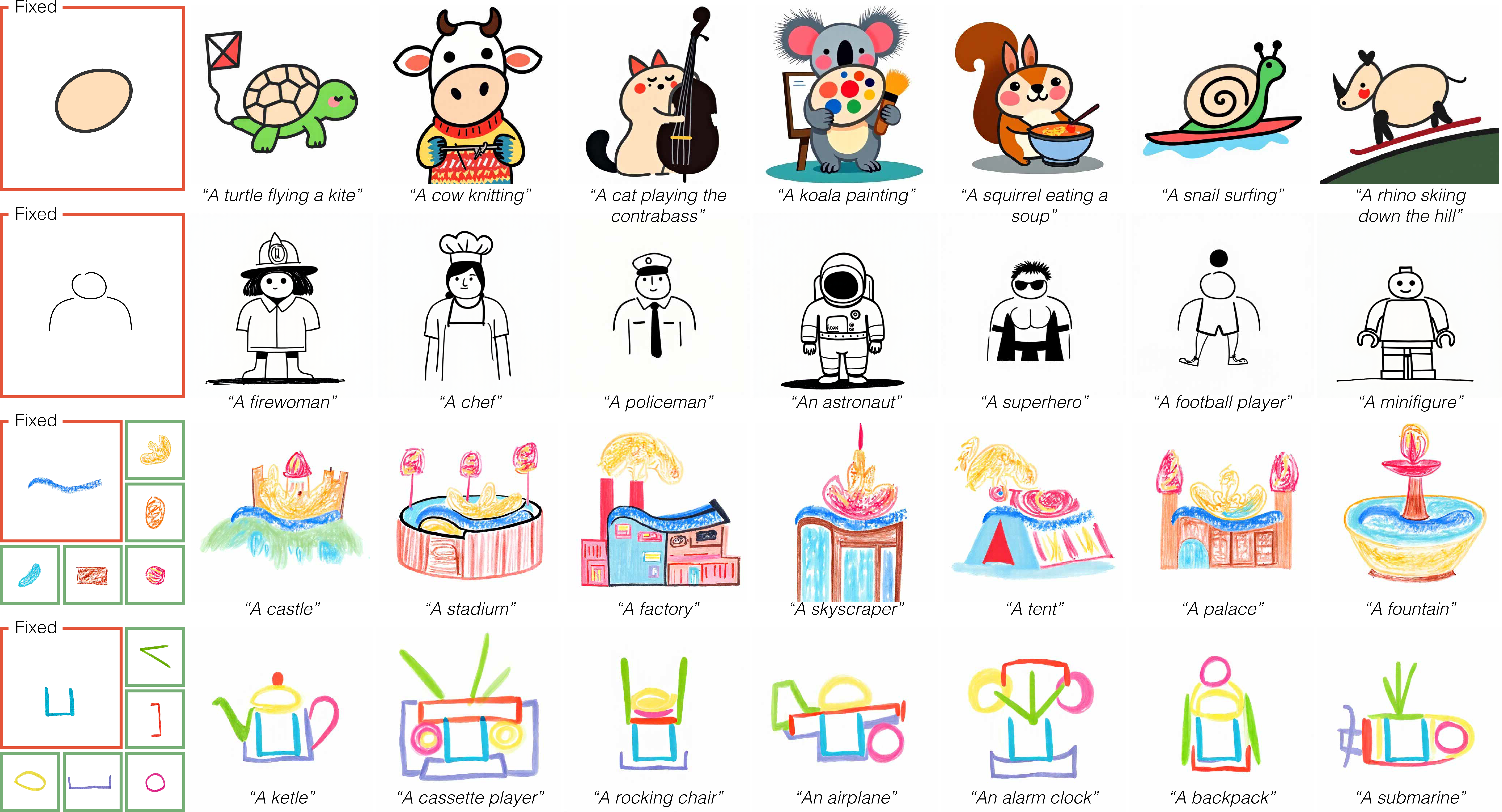
Our method can complete input drawings (red boxes) to
generate different concepts using additional (optional) abstract elements.
Control by details
Using different visual details (left) with a fixed set of base elements (top) enables further creative
extrapolation as users can define specific inter-relations between curves, shapes, or materials to influence
the overall look of the
generated images.
Abstaction Control
By increasing the coverage score, from left to right, we reduce he number of elements in the generated and
images, constraining the model to use only the abstraction set input (left).
BibTex
@inproceedings{hertz2026flowless,
title={FlowLess: Controlling Abstract Image Generation},
author={Hertz, Amir and Snavely, Noah},
booktitle = {European Conference on Computer Vision (ECCV)},
year={2026}
}